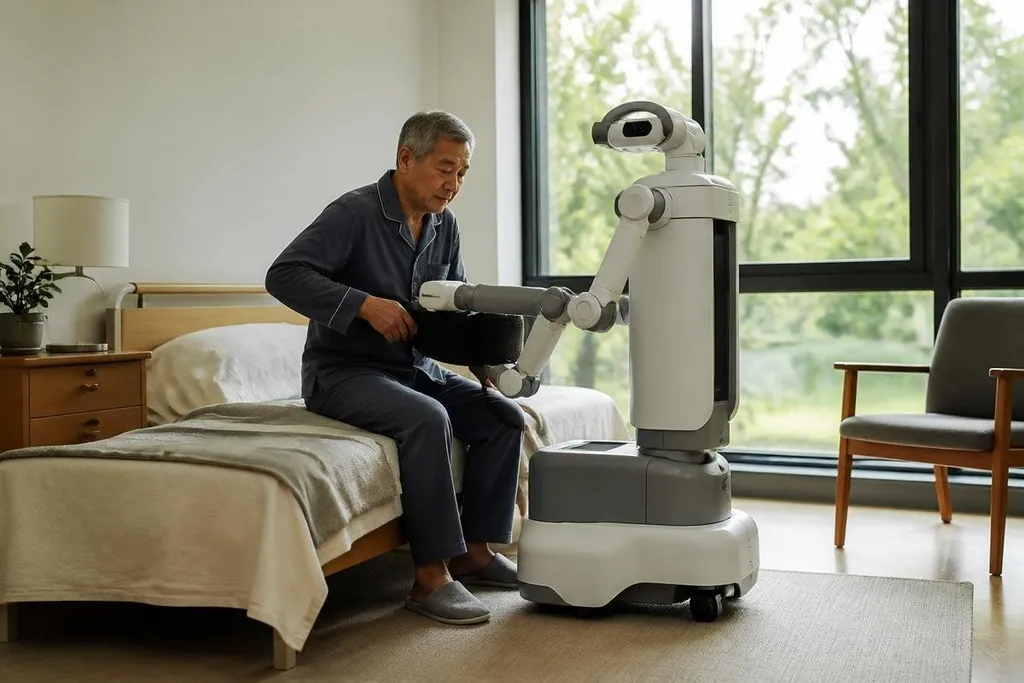
A caregiving robot may need to lift a person, fetch medicine, or call for help after a fall. Those jobs place very different demands on motors, sensors, software, and safety systems.
The global race will be judged in care settings, not on a stage. For a family, clinic, or care home, the useful question is simple: what task can the robot do safely, for how long, and at what cost?
Quick read
- Lifting people needs force control: the robot must sense contact and stop before a small error becomes an injury.
- Fetching items is easier to test: a clear route and fixed list give teams measurable results.
- Human help stays in the loop: care work includes judgment, trust, and urgent changes that software may miss.
The job comes before the shape
Laundry delivery has a different design brief from helping a person stand. The first may need a mobile base and a simple arm. The second needs careful contact sensing, controlled motion, and a way to stop when the person shifts weight.
That difference matters because human bodies don't behave like boxes in a warehouse. A person may move without warning, lose balance, or react to pressure with pain. A care robot must respond to those changes while keeping its grip and its balance.
Fetching can mean carrying a meal into a room or bringing a water bottle. The system might also collect a phone. Each task can be checked by route, time, delivery accuracy, and the number of times a person must step in.
A fixed task also gives buyers a fair way to compare products. “Helps with care” says very little. “Carries a 2 kg meal tray over a marked route and places it on a table” gives engineers and care staff something they can test.
The hard part is safe contact
Care robots must share space with people who may have limited strength, sight, hearing, or memory. Their sensors need to detect a hand, walker, bed, wall, and loose object without treating each one as the same kind of obstacle.
A lifting system adds another problem. The robot must know where its load is, how much force it applies, and what happens if the person slips. A mechanical stop can limit motion, but it can't decide whether a person is frightened, hurt, or asking to stop.
That is why human control remains part of the design. A remote operator may need to view the scene, speak with the person, or take over a task.
A visible stop button lets a care provider halt the robot quickly, while a clear fault record shows what happened afterward. Those controls matter more than a human-shaped body when the robot works near people. A dated Robot24.com robotics report can show whether a care robot has them outside a staged demonstration.
Teams can compete on many measures, but a care provider needs results tied to daily work. A robot that moves well in an empty room may still fail when a person, chair, pet, or visitor changes its route.
Useful measures include:
- Task success: how often the robot finishes without help.
- Safe stops: what happens when a person enters its path.
- Battery time: how many hours it works before charging.
- Recovery time: how quickly staff can fix a blocked route or failed grip.
- Care acceptance: whether people agree to use it after seeing the task.
The last measure needs care. The system may perform a task correctly and still be rejected if it feels intrusive, speaks poorly, or makes a person feel watched. Cameras and microphones also raise questions about storage, access, and deletion.
What buyers should ask first
A clinic or care home can cut through broad claims by asking for records from real tests. The answers should describe the task, the setting, the safety limits, and the staff time needed to run the system.
Use this checklist before a purchase or pilot:
- Name one task the robot must finish every day.
- Set the maximum load, route length, and working hours.
- Ask how the robot stops when a person moves into its path.
- Count the staff steps needed for setup, rescue, and cleaning.
- Check what cameras record and where that data goes.
- Set a failure limit that ends the trial if safety or care time gets worse.
A pilot should measure the work around the robot as well as the robot itself. If staff spend more time supervising, charging, and resetting it than the task saves, the system has missed its purpose.
What happens next
The strongest care robots will probably start with narrow duties that teams can measure, then add harder tasks after months of safe use. Human-shaped designs may help with tools and rooms made for people, but shape alone won't prove value.
I'd back the robot that completes one useful care task safely on a repeatable schedule over the robot that performs a wider demo. The deciding record is still missing for many systems: how often they work in real care settings without a person taking over.